
Silicon carbide (SiC) is among the most widely used advanced ceramic materials in modern industries. Its special properties in mechanics, heat, and electricity make it useful in various industries.
SiC outperforms metals and other traditional ceramic materials in its various uses, including furnace tubes, mechanical seals, and more. In this article, you will learn how SiC properties are beneficial to you in practical operations.
What is Silicon Carbide?
Silicon carbide is a ceramic compound formed by silicon and carbon atoms. Almost all industrial-grade silicon carbide is produced using high-temperature conditions.
Silicon carbide has more than 200 crystalline forms, known as polytypes of the compound. They are different in structures to some extent. Some important polytypes include 4H-SiC, 6H-SiC, and β-SiC.
Further Reading: What is Silicon Carbide?
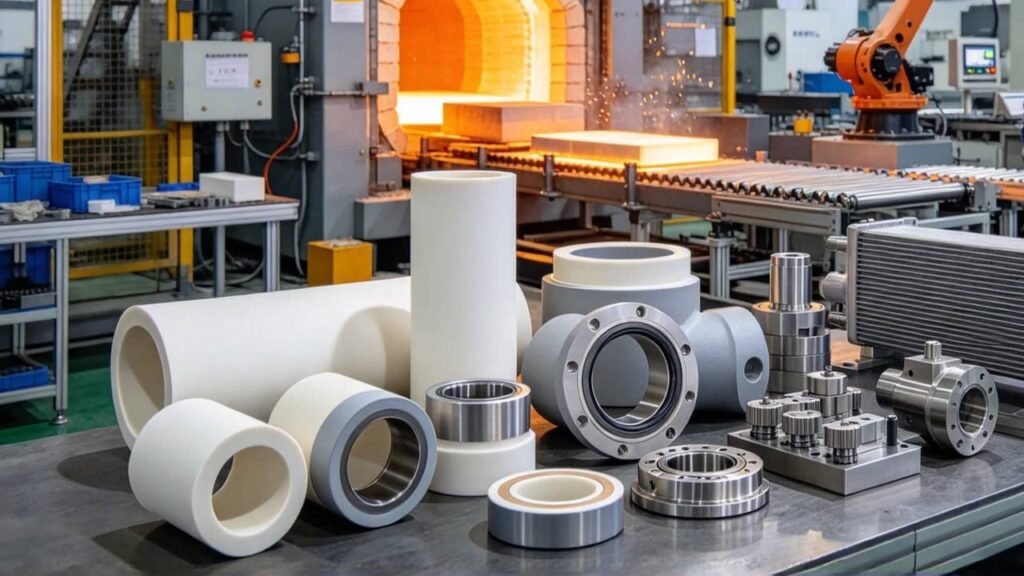
Physical Properties of Silicon Carbide
You may wonder why silicon carbide owes its industrial dominance; some of the reasons are due to a set of exceptional physical traits. Below, we explain each key property in detail.
Hardness & Wear Resistance
Hardness is the most widely known advantage of silicon carbide. On the Mohs scale, silicon carbide scores just below diamond and boron carbide.[2] This extreme hardness brings excellent wear resistance under abrasive conditions.
This means SiC will maintain its surface finish and dimensional accuracy over long service lives. Unlike metal, which will scratch, gall, or deform under friction. So silicon carbide is perfect for applications exposed to constant abrasion. For example, pump seals, bearing surfaces, and material handling liners.
Thermal Stability
Thermal performance sets silicon carbide apart from almost every other structural ceramic. High-purity SiC exhibits thermal conductivity of 320~490 W/m·K at room temperature. This number exceeds that of many metals.
Technical-grade silicon carbide ceramics typically measure 100~ 200 W/m·K, still far higher than alumina (20-30 W/m·K) and most stainless steels. With such superior heat transfer, SiC enables efficient heat dissipation in power electronics and furnace components.
Silicon carbide does not melt at standard pressure. In normal air environments, it maintains stable performance up to about 1,650℃. In inert or vacuum atmospheres, it can operate reliably above 2,000℃. Besides, silicon carbide can withstand rapid heating and cooling cycles without breaking.
Mechanical Strength
Silicon carbide delivers superior mechanical strength that remains stable even at high temperatures. High-density sintered SiC shows flexural strength of 400~500 MPa, with compressive strength reaching 2200~2500 MPa.
So what benefits do these data bring to practical industrial uses? Most engineering metals lose significant strength as temperatures rise. But silicon carbide retains most of its mechanical properties well above 1,000℃. It resists deformation under load at temperatures that would soften steel.
Corrosion Resistance
Silicon carbide shows good resistance to most acids, alkalis, and corrosive chemicals. Its strong bonds remain stable in many harsh chemical environments that rapidly attack metals and other ceramics.[2] It resists oxidation in air up to high temperatures by forming a thin protective silica layer on the surface.
Reaction-bonded silicon carbide, with free silicon content, has slightly lower chemical resistance. For the most aggressive chemical environments, fully sintered silicon carbide delivers the best long-term performance.
How SiC’s Physical Properties Drive Industrial Performance?
What matters most is how these properties benefit your operations. In this section, we connect silicon carbide’s physical traits to tangible improvements in your industrial systems.
High-Temperature Process Equipment
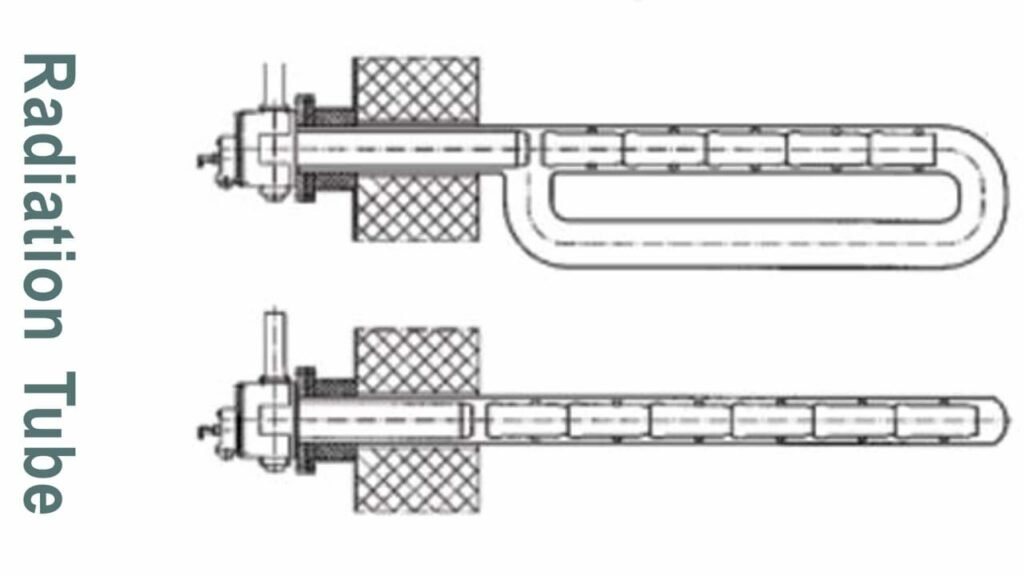
If you operate industrial furnaces, kilns, or thermal processing lines, silicon carbide’s thermal properties can greatly improve your working time and energy efficiency. Its ability to withstand 1,600℃+ temperatures in air means longer service life and fewer shutdowns for replacement.
SiC radiant tubes, furnace rollers, and kiln furniture can be used when higher temperatures are required with less thermal distortion.[3] In addition, their high thermal conductivity is useful for even distribution of heat for better quality of the products. Rapid heating and cooling cycles can be achieved without the risk of cracking.
Wear-Intensive Fluid Handling Systems
Abrasive wear drives most maintenance costs for pumps, valves, slurry pipelines, and mixing equipment. Silicon carbide’s extreme hardness and wear resistance extend the service life of these parts in these applications.
In mining, mineral processing, and wastewater systems, silicon carbide parts often outlast metal ones by 5~10 times. You can install SiC mechanical seal faces, pump liners, and valve trim to reduce leakage and cut replacement frequency.
Silicon carbide also provides good chemical resistance, which means it can handle acidic or caustic slurries without corrosion-related failures. You get both wear protection and chemical durability in a single material solution.
Semiconductor & Power Electronics
In semiconductor manufacturing and power electronics design, silicon carbide’s semiconductor properties enable performance gains impossible with silicon alone.
Its wide bandgap allows power devices to operate at higher voltages and frequencies. For power conversion systems, you can use silicon carbide components to achieve higher energy efficiency, smaller cooling systems, and more compact device packages.[3]
During wafer fabrication, silicon carbide wafer carriers and process chamber components also benefit from its purity, thermal stability, and plasma resistance.
3 Main SiC Grades & Their Property Differences
Not all silicon carbide ceramics perform the same way. Here are the 3 most common industrial grades; each serves distinct applications.
Reaction-Bonded Silicon Carbide (RBSiC / SiSiC)
RBSiC is produced by infiltrating porous carbon preforms with molten silicon. This grade typically contains 8~15% free silicon and achieves near-zero porosity.[1] It offers good thermal conductivity and flexural strength. Limited by the melting point of free silicon, the maximum service temperature reaches about 1,380℃.
RBSiC excels in large, complex-shaped components, such as burner nozzles, kiln furniture, and vacuum chucks. Its relatively lower manufacturing cost makes it a cost-effective choice for many structural and thermal applications.
Pressureless Sintered Silicon Carbide (SSiC)
Pressureless sintered SiC is made from ultra-fine SiC powder sintered at over 2,000℃ without pressure. SSiC contains virtually no free silicon and achieves a high density of 3.10~3.20 g/cm3. It delivers the highest hardness, the best wear resistance, and the strongest corrosion resistance of all standard SiC grades.
SSiC is your best choice for mechanical seals, pump components, bearings, and chemical processing equipment exposed to highly corrosive media. It performs reliably at temperatures up to 1,600℃ in oxidizing environments.
Recrystallized Silicon Carbide (RSiC)
Recrystallized SiC is formed by sintering SiC powder at very high temperatures in the absence of sintering aids.
RSiC has an open porosity of 11~15% and a lower density (2.70~2.85 g/cm3) than dense grades. But it offers excellent thermal shock resistance, which can operate at temperatures above 2,000℃ in inert atmospheres.
You will commonly find RSiC used in kiln furniture, setter plates, and high-temperature furnace tubes where thermal stability matters more than mechanical strength.
FAQs
Does silicon carbide conduct electricity?
Pure silicon carbide acts as a semiconductor. Its electrical resistivity varies by polytype and doping.
How does silicon carbide compare to alumina in thermal conductivity?
Silicon carbide has 4~8 times higher thermal conductivity than standard alumina ceramics. This makes SiC far superior for heat-dissipating components.
Can silicon carbide be machined into complex shapes?
Yes, but difficult. Silicon carbide is extremely hard and cannot be machined with conventional metal tools. Green-state forming, diamond grinding, and lapping are standard methods for shaping finished SiC components.
What is the maximum temperature silicon carbide can withstand in air?
In standard air environments, up to approximately 1,600~1,650℃. In inert or vacuum conditions, SiC remains stable well above 2,000℃.
Is silicon carbide stronger than steel?
Silicon carbide is much harder and stiffer than steel, with higher compressive strength. However, it is a brittle ceramic and has lower tensile strength and impact toughness than most steels.
Which silicon carbide should I choose for chemical processing?
For strong acids, alkalis, and highly corrosive environments, pressureless sintered silicon carbide (SSiC) is the preferred choice.[1]
Conclusion
When you select the right SiC grade for your operating conditions, you gain longer component life, reduced maintenance downtime, improved process efficiency, and lower total cost of ownership.
If you are evaluating silicon carbide for your specific application, you can contact Newthink New Materials for more information. With years of experience in silicon carbide ceramics, we support your industry from SiC parts design to installation.
Reference
[2] Harris, G. L. (Ed.). (1995). Properties of silicon carbide (No. 13). Iet.